ACETYLSERYLTYROSYLSERYLISOLEUCYLTHREONYLSERYLPROLYLSERYLGLUTAMINYLPHENYLALANYLVALYLPHENYLALANYLLEUCYLSERYLSERYLVALYLTRYPTOPHYLALANYLASPARTYLPROLYLISOLEUCYLGLUTAMYLLEUCYLLEUCYLASPARAGINYLVALYLCYSTEINYLTHREONYLSERYLSERYLLEUCYLGLYCYLASPARAGINYLGLUTAMINYLPHENYLALANYLGLUTAMINYLTHREONYLGLUTAMINYLGLUTAMINYLALANYLARGINYLTHREONYLTHREONYLGLUTAMINYLVALYLGLUTAMINYLGLUTAMINYLPHENYLALANYLSERYLGLUTAMINYLVALYLTRYPTOPHYLLYSYLPROLYLPHENYLALANYLPROLYLGLUTAMINYLSERYLTHREONYLVALYLARGINYLPHENYLALANYLPROLYLGLYCYLASPARTYLVALYLTYROSYLLYSYLVALYLTYROSYLARGINYLTYROSYLASPARAGINYLALANYLVALYLLEUCYLASPARTYLPROLYLLEUCYLISOLEUCYLTHREONYLALANYLLEUCYLLEUCYLGLYCYLTHREONYLPHENYLALANYLASPARTYLTHREONYLARGINYLASPARAGINYLARGINYLISOLEUCYLISOLEUCYLGLUTAMYLVALYLGLUTAMYLASPARAGINYLGLUTAMINYLGLUTAMINYLSERYLPROLYLTHREONYLTHREONYLALANYLGLUTAMYLTHREONYLLEUCYLASPARTYLALANYLTHREONYLARGINYLARGINYLVALYLASPARTYLASPARTYLALANYLTHREONYLVALYLALANYLISOLEUCYLARGINYLSERYLALANYLASPARAGINYLISOLEUCYLASPARAGINYLLEUCYLVALYLASPARAGINYLGLUTAMYLLEUCYLVALYLARGINYLGLYCYLTHREONYLGLYCYLLEUCYLTYROSYLASPARAGINYLGLUTAMINYLASPARAGINYLTHREONYLPHENYLALANYLGLUTAMYLSERYLMETHIONYLSERYLGLYCYLLEUCYLVALYLTRYPTOPHYLTHREONYLSERYLALANYLPROLYLALANYLSERINE
July 20, 2006
Longest

July 13, 2006
Octuple Vision?
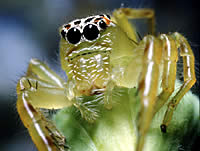
All spiders, arachnids, have eight legs.
But how many eyes do they have?
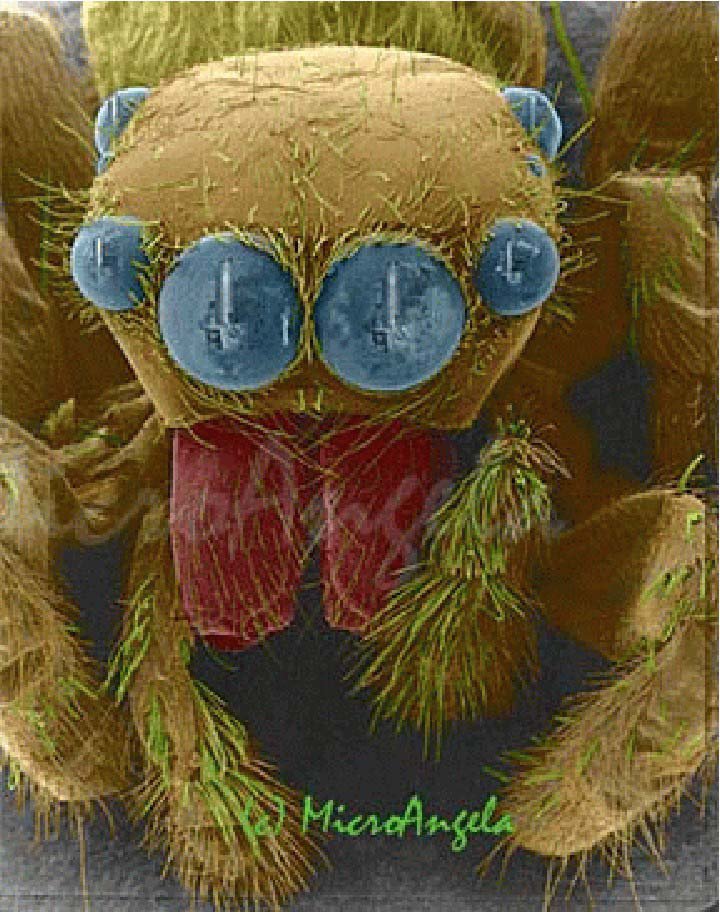
Most of them have eight eyes! Which enables them to have vision like this:
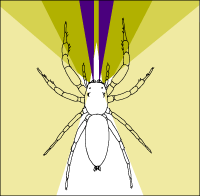
But most spiders don't have good eyesight, despite the many eyes. They depend more on their touch, vibration and taste stimuli.
However, hunting spiders, such as the 2nd picture above, have sharp vision in order to help catch prey.
June 29, 2006
How Do Butterflies Feed?
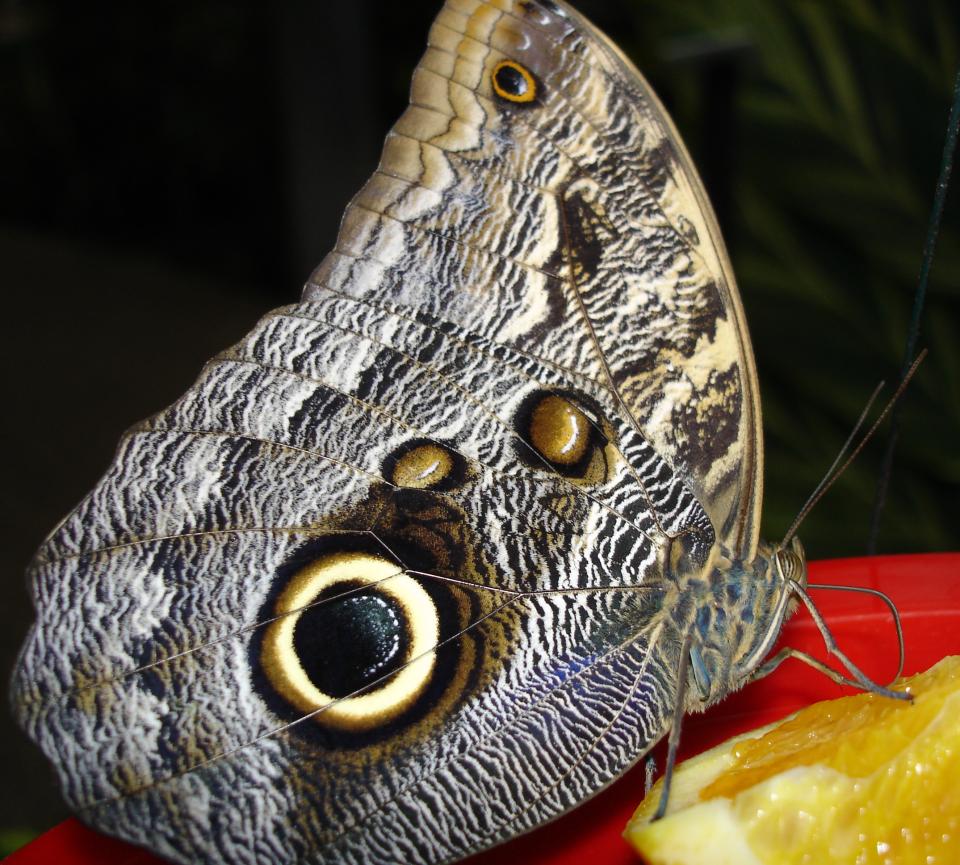
Well, if you look at the picture below carefully, you will notice that there is like a rolled up ribbon -like thing where the mouth should be. That thing, is called a 'proboscis', which is a turbular sucking organ. When the butterfly has found nectar, it extends its proboscis like a party blow-out.
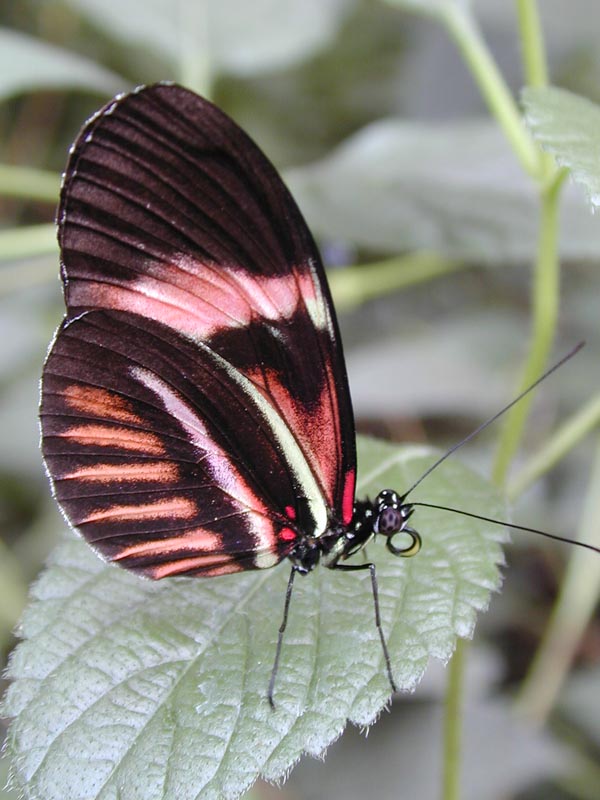
A Monarch Butterfly
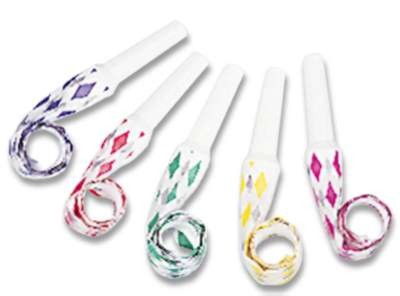
A butterfly's proboscis is like a party blow-out.
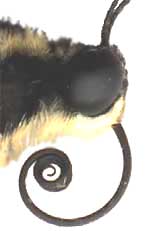
A butterfly's proboscis up close.
June 26, 2006
Of butterfly&mothballs
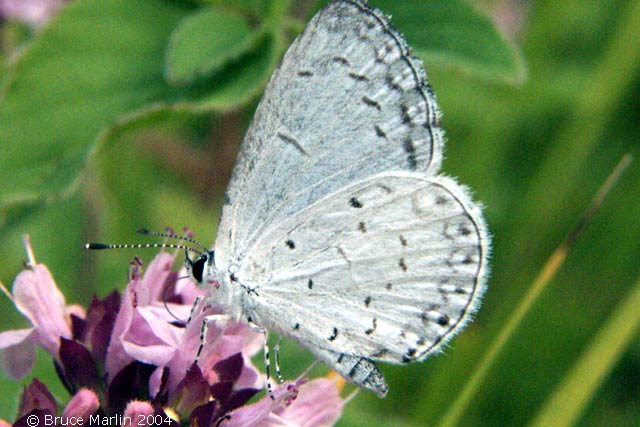
a Spring Azure butterfly
Moths however, often get the bad name...most probably from 'mothballs'. But anyhow, the common "eyes" found on moths aren't as fascinating as the feathery snow white found on Spring Azures.
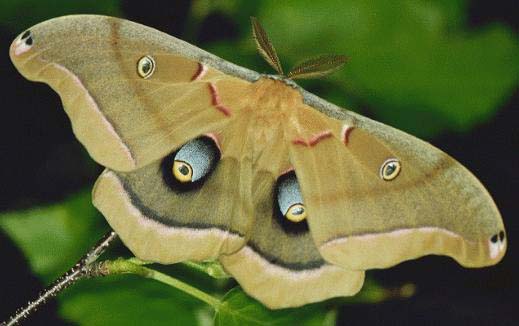
a polyphemus moth
Then again, there are moths which do not have "eyes" their wings. So the question would then be, how do you tell the difference between a moth and a butterfly?

Which is which?

Well one way to tell the difference between a moth and a butterfly is by looking at how it rests. A moth will always rest with its wings open while a butterfly always keeps its wings at a vertical position during its resting position.
So the next time you see a 'butterfly' resting with its wings open, you can be sure it's a moth! =)
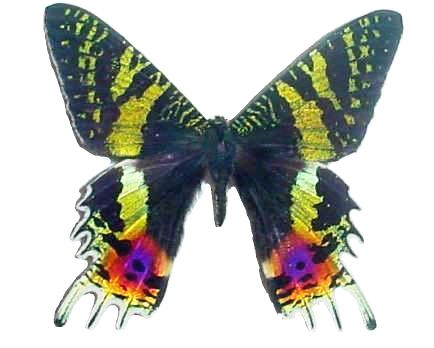
PS. It is not true that moths are uglier than butterflies. Moths have awesome colours, as it is with this sunset moth (Urania riphaeus).
June 19, 2006
Snail? Slug?
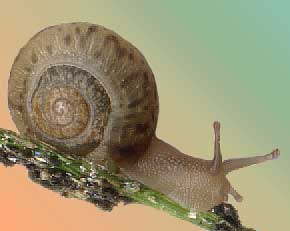
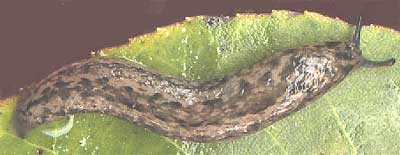

I personally prefer snails. Urgh look at that slime! :S
June 13, 2006
Lesser Known Fact of the Giant Panda

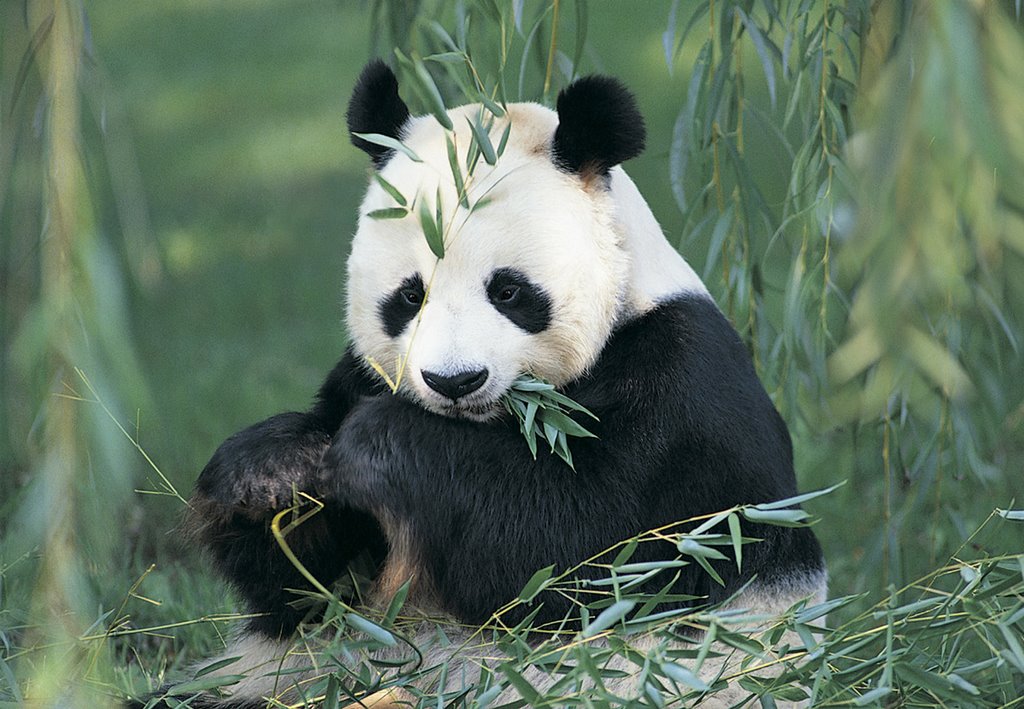

Pandas are cute.
Pandas are also endangered. We all know that, don't we?
And we all know why too; the normal reasons...habitat lost and low birthrate.
Another thing we all know is that pandas eat shoots and leaves.
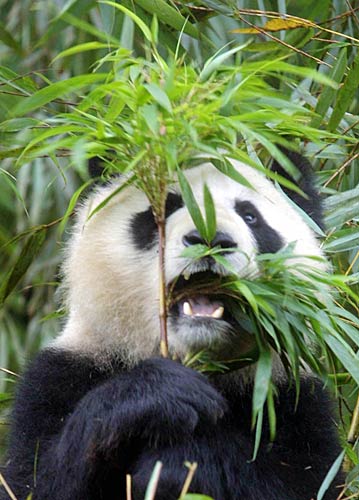
What kind of shoots and leaves?
Well, bamboo shoots and leaves of course!
One thing not many of us know that one of the reasons why the panda is endangered is because of the life-cycle of it's staple food: the forementioned bamboo.
Although the bamboo trees we see around don't have flowers, bamboo trees do flower. It's just that they flower on the average every 28 years.

The catch here is that bamboo is monocarpic. This means that after they have finished flowering, the plant will die. According to Wikipedia, the plant being monocarpic is thought to have evolved because it reduces the effect of predators of the seed, who would be unable to depend on a predictable food supply.
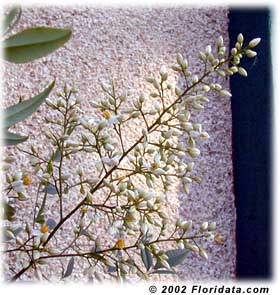
To add to that, bamboo trees flower together, at the same time.
So every 28 years or so, the entire bamboo forest dies, leaving the pandas with no food. And if they're not successful in finding another bamboo forests, poof, off they disappear (to heaven I meant...or wherever animals go when they kaput. The sheol maybe. Heh) .
A Bamboo Flower
June 10, 2006
Unfrozen Reindeer
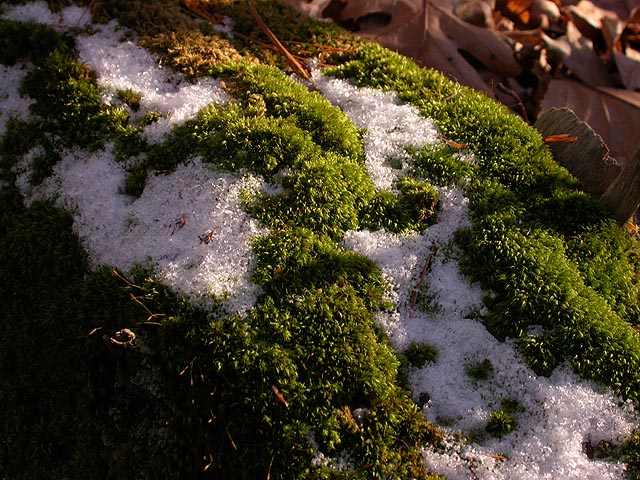
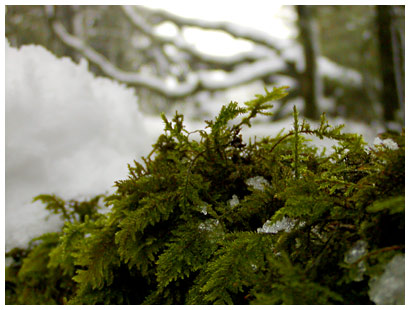

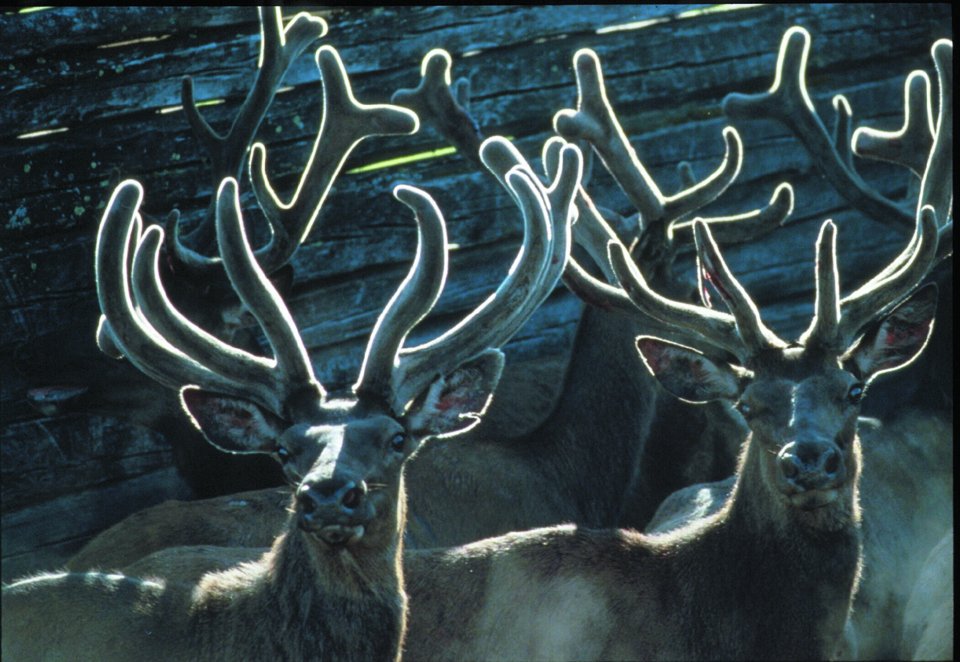
All of us are pretty familiar with reindeer, them being made popular along with Santa Claus and chimneys and snow. Oh, and not forgetting dear Rudolph with his red nose.
But it is true, these herbivorous carribou have this warm, fatherly look about them. In my imagination, when a reindeer talks, it will be a deep, gentle and soothing tone to it. Lol.

But as warm and friendly we might like them to be, reindeer have to make a pretty brutal journey across theArctic region annually. Why brutal? Clearly you've never been to the Arctic. It's just snow and ice and a dimly lighted sun. Despite being herbivores, food is still pretty rare.
Not to mention the freezing temperatures? It's pretty obvious reindeer don't have the kind of blubber penguins, polar bears and walruses all have.
Their simple anti-freeze trick? Moss.
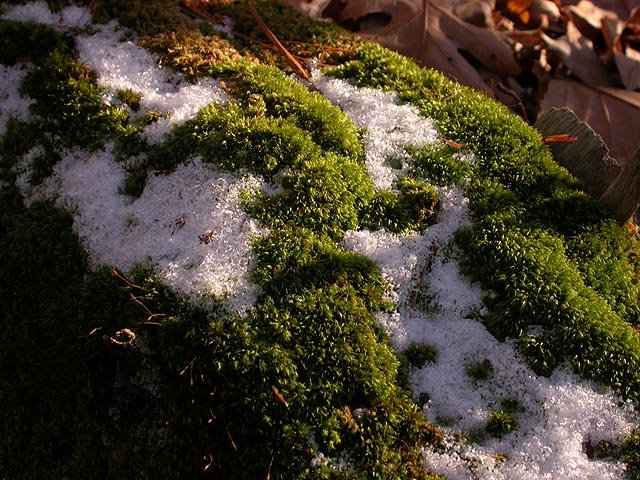
Most animals don't eat moss because it isn't easy to digest and has little nutrients. I can't tell you about the taste since vegetables (which I assume most herbivores love) isn't exactly peanut butter to me.
Anyway, before the long journey, reindeers will fill up with lots and lots of moss because it contains a chemical that helps the body of the reindeer keep warm. This prevents them from freezing to death.
I wonder if it works with humans too. Then the Everest climbers could just keep a diet of strawberry-flavoured moss or something. ;)
June 08, 2006
Cow eyes
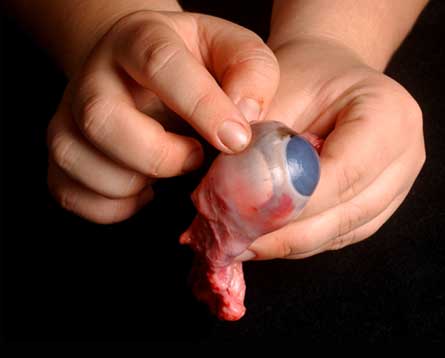
This is the eyeball of a cow.
Cow eyes are like ours, except that they have only 4 muscles.
Human eyes have 6 muscles, which enables us to roll our eyes.

So yeap, if you see a cow rolling its eyes at you, you're really in for it.
January 09, 2006
Gila Monster

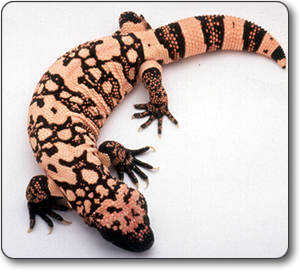

This is one of the only two venomous lizards in the world, the other being the Mexican Beaded Lizard (Heloderma horridum). This is called the Gila Monster. And contrary to popular Malaysian belief, no it's not called gila monster because it's crazy (gila in Malay means crazy), but named after the Gila Basin in Arizona.
There are two types of gila monsters- the reticulated gila monster (Heloderma suspectum suspectum) and the banded gila monster (Heloderma suspectum cinctum). Gila monsters eat small mammals, lizards, frogs, insects, birds and bird eggs. They have a forked tongue and a very keen sense of smell to help it track down prey.
Their stumpy tails are for storing fat, in which they use up when hibernating during winter. They are venomous, but not in the sense of venomous as we know- they don't have fangs like snakes, but their venom glands are like our saliva glands. The gila monster is said to use its venom for defensive purposes as most of its prey are small and do not require venom to kill it. Its bite is a brutal half-inch deep one, sometimes tearing the flesh away to let the poison flow deeper into the wound. As brutal and violent as this sounds, the gila monster's venom is not usually fatal to humans, though the bite will cause awful pain.
Despite the venomous bites and crazy name, gila monsters are very beautiful lizards, and in fact, not monstery at all.
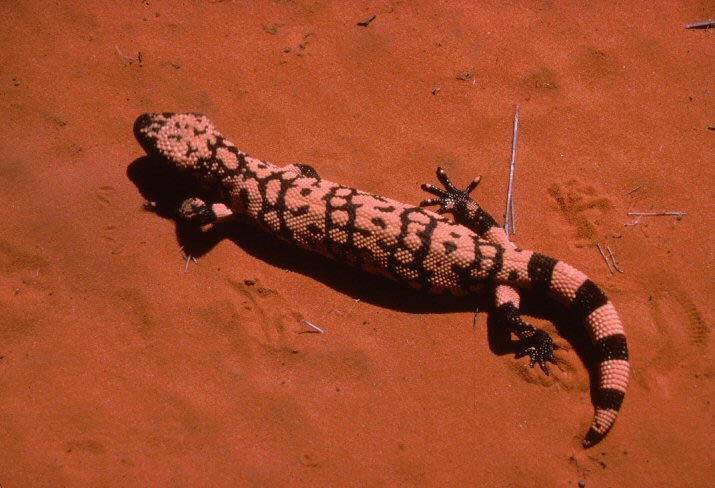
Newly hatched babies (they are oviparous) have vibrant and more distinct coloured skin:
November 27, 2005
Swimming Whiskery Tongues

I always thought that catfish looked a little silly with their moustaches and whiskers. But then again, it was by their whiskers and moustaches that I recognized them anyway. So I should say they look 'distinguised'. Yeah.
Ok, when I say the word tastebud, which body part automatically pops into your head? The tongue, of course. But hey, believe or not, the catfish has tastebuds all over its body! There are tastebuds on their fins, back, belly, sides, and even on their tail. It's like a huge, swimming tongue with whiskers:
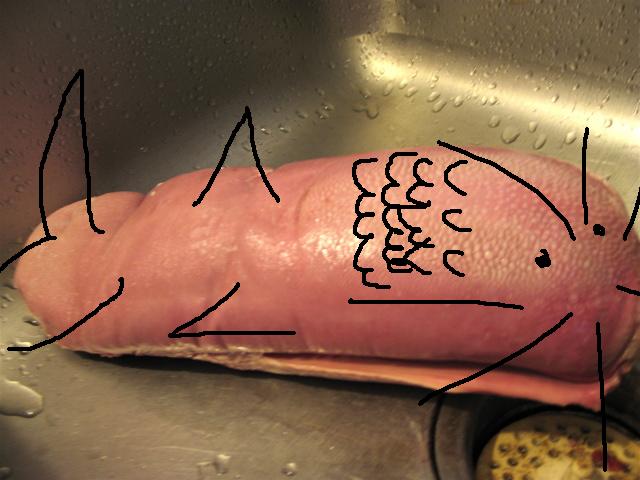
Ok ok, I confess, that's actually a cow's tongue, with drawn whiskers and fins and all. I was just trying ellaborate a point.
The highest concentration of tastebuds found outside the mouth, are just below the whiskers. Apparently there are many volcanos near the area, if looked under a microscope. And each, mini volcano is a tastebud. Pretty cool eh?
Anyway, the tastebuds on the body do serve a function. They help detect food by detecting chemicals, then the fish will be able to locate it by using it's whiskers as little "feelers", before the tastebuds in the mouth examine it to see whether the food's tasty or not.
On the estimate, a 6 inched catfish has about 6 million tastebuds on the average. Man, imagine those Mekong Catfish!

I'm guessing what... Gazillions of trillions of zillions?! And man, you won't need a microscope to check out the volcanic tastebuds. Heh.
November 24, 2005
*pooh!* What's that smell?

And you thought herring were common fish-and-chips fish?? Think again! They're extremely special creatures- they communicate by farting-a study suggests!
Marine biologists have known that herrings have excellent hearing, but they never knew what it was used for. And then they discovered that the fish actually make small, high-frequency noises at night, by releasing air from their anuses!
Wheeeheeee... Imagine, if we communicated like that: *prupp pruup pruuuuuuup* *I love you*
Really, amazing fish. In fact, I know some one who would make a very socialble herring. ;-)
November 05, 2005
Leeches
Say that word aloud and you get the idea of a leech.
L-E-E-C-H. What pops into your head? A blood-sucking, slimy, dancing, drunk, black worm, correct?
Exactly what it is.
Leeches are segmented worms or anelids, cousins of the earthworms. The wonderful part about leeches is they have suckers at both ends. They are sanguivorous, which means they feed on blood of other animals.
A leech detects its prey by sensing movement and light. To imagine the way it moves, just think of a flexible tube with two plumber suckers at each end, dancing like a slinky down the stairs.
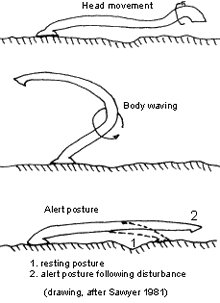
The usual jungle leeches you find on rainy days in Malaysian forests (the jawless leeches or Rhyncobdellida) don't have jaws to bite, instead, they have this needle-like protusion called a proboscis (like butterflies for nectar), which they inject into one of our skin pores, and happily begin to drink. They inject an anti-coagulant hirudin, which floods the wounded pore, helping the leech to relax and allow the blood to be ingested.
According to www.austmus.gov.au/factsheet/leeches :
There may also be a delayed irritation and itching after a bite. There appears to be no support for the theory that mouthparts left behind after forced removal of the leech causes this reaction. Can leeches transmit disease? There is no evidence to suggest that they do.
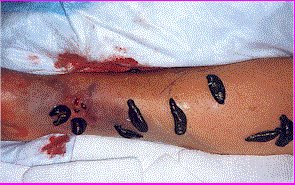
Leeches have been known over the centuries to be used for medical purposes. In fact, pharmacies nowadays supply leeches to hospitals and clinics! They put leeches on the body part which has been infected, and in a very literal sense, the leech will suck out all the bad blood.
Shown here below is the process of decompression for a woman who had forearm hematoma. And which the leeches helped return her arm to its normal state, all pink and flexible.
October 07, 2005
Figs
Luke 13:6-7
6Then he told this parable: "A man had a fig tree, planted in his vineyard, and he went to look for fruit on it, but did not find any. 7So he said to the man who took care of the vineyard, 'For three years now I've been coming to look for fruit on this fig tree and haven't found any. Cut it down! Why should it use up the soil?'
Matthew 21:18-20
The Fig Tree Withers 18Early in the morning, as he was on his way back to the city, he was hungry. 19Seeing a fig tree by the road, he went up to it but found nothing on it except leaves. Then he said to it, "May you never bear fruit again!" Immediately the tree withered.
20When the disciples saw this, they were amazed. "How did the fig tree wither so quickly?" they asked.
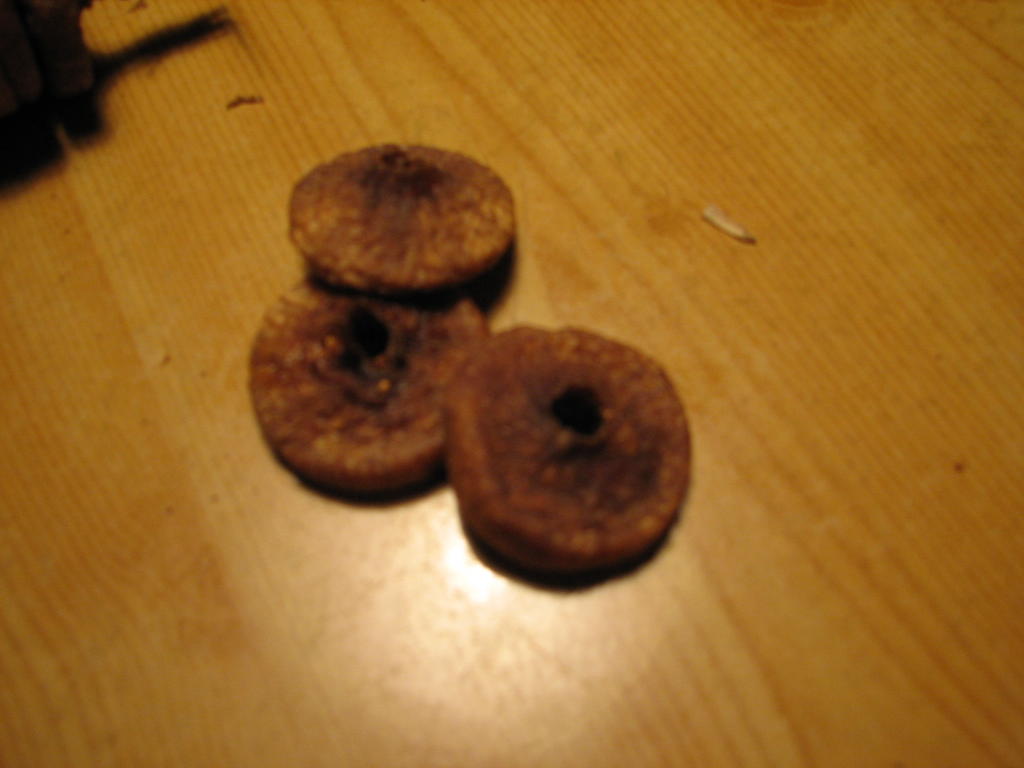
Before I went to Israel the only figs I've tasted were the kind in eaten in the Old Testament, 'cakes of figs'. This kind, my auntie brings back from Pakistan. They look like this:
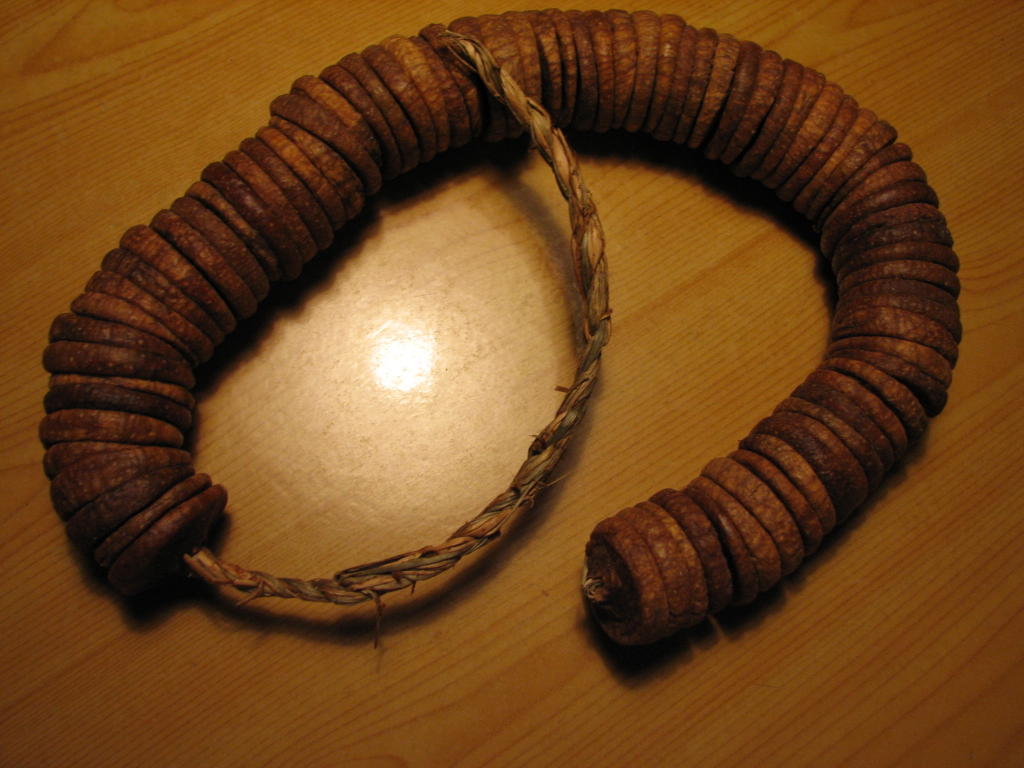
It's called a cake of figs only when it's like this: (they're all threaded through the middle with a weaved rope)
They became coins by being squished and pressed down, when actually they originally looked so fresh and succulent like this green one:
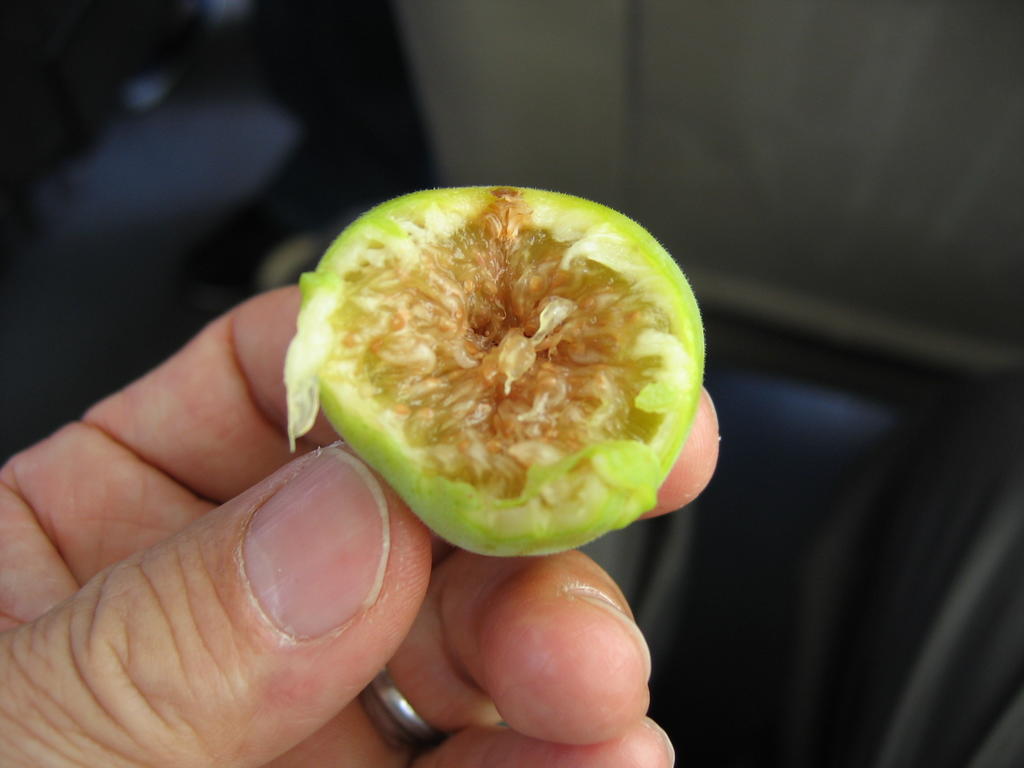
The Figgy Truth
Well I suppose you know for a fruit to become a fruit, it has polinated, usually by insects. Well the fig tree is polinated by wasps. But this form of mutualism is different from most, the wasps lays its eggs inside the fruit, getting a place to lay its eggs. And in turn, it polinates the fig tree.
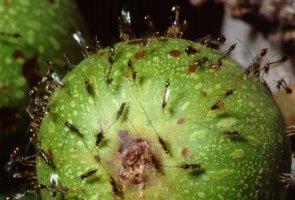
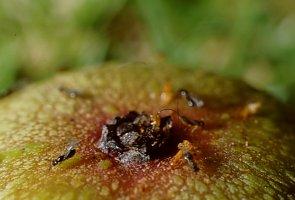
However, not all the baby wasps make it out alive. *gasps*
Yes, what I meant was, when we eat figs, fresh or dried, we snack up some baby wasps too.
=)
But really, fresh figs are wonderful things.
Don't let this post be a stumbling block towards your fig faith. :
September 22, 2005
Fishy Sexual Vampirism

This is a deep sea angler fish.
The female, which is the main fish you see, is the size of a tennis ball.
It has big savage teeth, little nasty pin eyes . . . and a rod lure off the top of its head with a glowing tip to coax in stupid prey."
The male, which "looks like a black jellybean with fins", are those things hanging from the female. When a male finds a female, he bites into her side, never letting go. "He drinks her blood, in return for giving her sperm," Dr Norman said.
The flesh of the two fish eventually fuses "and they remain connected, permanently. It's sexual vampirism, with a bit of dwarfism thrown in. They have found females with up to six males attached."
Man..
Talk about what lies beneath..
September 14, 2005
Cumbre Vieja
 tsu·na·mi
A very large ocean wave caused by an underwater earthquake or volcanic eruption.
[Japanese : tsu, port + nami, wave.]
With the recent Aceh Tsunami and the Gulf Coast's Hurricane Katrina, I've decided to post something more "current events"-like. And yes, deadhonest.blogspot.com is capable of that.
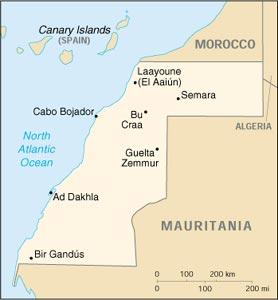 Of the coast of Morroco and Western Sahara, lies a group of islands which, are of Spain's. One of them is La Palma and La Palma has a volcano, called Cumbre Vieja.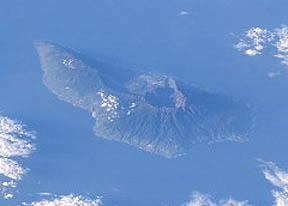
Cumbre Vieja Volcano,
on La Palma Island.
La Palma is most volcanically active of the Canary Islands in past 500 years, the last being in 1971. The previous eruption in 1949, caused the western half of the volcano ridge to slip a few meters down into the sea, leaving a 2km-long fracture (see picture below).

The next time the volcano erupts, it is very likely to cause a huge chunk of rock (approximately weighing 500 billion tons!) into the sea, a dome of water 900 meters & tens of miles wide would form, only to collapse and rebound.
Then as it slides deeper in to the sea, a mega-tsunami will develop. Within 10 minutes, the mega-tsunami would have moved a distance of almost 250 km.
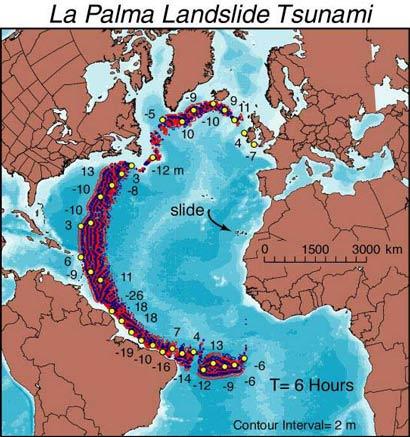
The mega-tsunami will totally polish off the Western Sahara coast, Florida & the Carribean will have to brace themselves for waves as high as 50 meters, 8 or 9 hours after the landslide. New York, Boston, Washington DC, Miami and Virginia will be damaged badly too, with 10-25 meters high waves. The waves would hit the coasts of England, Spain, Portugal and France too, in smaller but substantial waves.
And of course, did I mention all this would amount to trillions of dollars in damage repairs. And imagine how many people will perish, suffer and lose hope because of this.
Wow. Talk about our ignorance.
Sources: